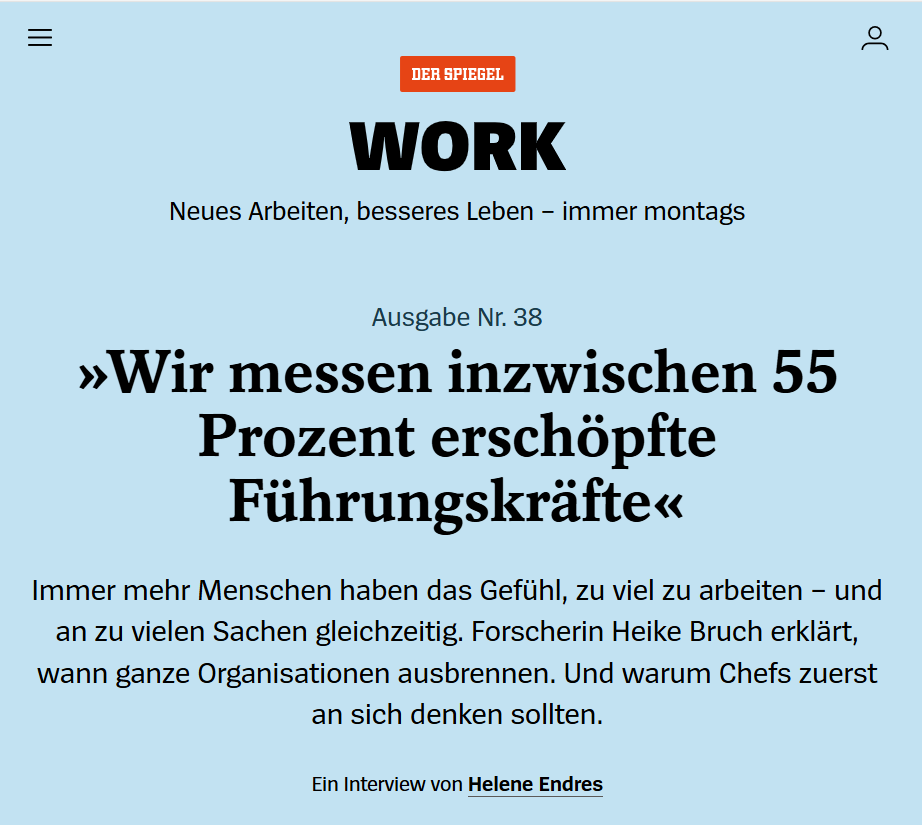
How can companies remain productive and healthy even under sustained high pressure? In a recent SPIEGEL interview, Prof. Dr. Heike Bruch discusses the difference between high-energy and high-pressure companies—and the role that leadership, culture, and people management play in this.
Pressure in companies is high—and it is increasingly taking its toll. Current research from IFPM-HSG shows that around 55 percent of managers are now exhausted. At the same time, researchers have observed a significant increase over several years in companies operating in what is known as the high-pressure mode.
However, high pressure alone is not the decisive problem. What matters is how organizations handle it. While high-pressure companies pass external pressure inward, thereby intensifying overload, frenetic activity, and exhaustion, high-energy companies succeed in translating pressure into positive, productive energy. Research from IFPM-HSG shows that these companies are able to combine high performance with engagement, health, and a positive working climate.
Three Success Factors of High-Energy Companies
In the conversation with SPIEGEL, Heike Bruch highlights three key starting points:
1. Invest long-term in leadership, culture, and generations
Modern leadership and a consciously developed corporate culture provide orientation and stability—especially in times of high change dynamics. Companies that continuously invest in leadership, values, and culture create better conditions for remaining healthy and productive even under pressure.
2. Think of people management holistically
Technological transformation and cultural change cannot be shaped separately from one another. A future-oriented people management connects leadership, culture, people, and technology transformation. Particularly in light of the increasing use of artificial intelligence, this connection becomes a central prerequisite for sustainable transformation.
3. Make energy and culture measurable
Culture and energy should not be viewed solely as ‘soft’ factors. Companies can systematically capture the state of energy, exhaustion, leadership, and culture—and link this data with performance indicators. This makes visible the contribution that organizational energy makes to health, innovation capacity, and economic success.
The underlying research from IFPM-HSG is based on a long-standing data set with more than 160 companies and 28,000 employees. It shows: sustainable high performance does not arise from ever-increasing pressure, but where companies consciously mobilize, focus, and maintain energy.
This raises a central question for leaders: Am I amplifying the existing pressure—or am I able to translate it into clarity, focus, confidence, and energy?
The full interview with Prof. Dr. Heike Bruch has been published in the latest issue of SPIEGEL WORK.