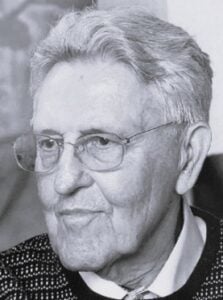
Professor Rolf Wunderer passed away on January 5, 2026. With his passing, the University of St.Gallen, the Institute for Leadership and Human Resource Management, and the leadership community have lost a remarkable scholar.
Rolf Wunderer was not only the founder and long-time director of the Institute for Leadership and Human Resource Management at the University of St.Gallen (IFPM-HSG), but above all, a passionate thought leader for leadership, value-oriented management, co-entrepreneurship, and a modern role for human resource management. He was one of the first to understand leadership not only as a business discipline, but as a human, value-oriented, and deeply personal task involving head, heart, and hand.
His scientific works shaped entire generations of students, executives, and researchers. They set timeless standards and continue to form the foundation of modern leadership and human resource management today.
His most influential fundamental work is probably «Leadership and Collaboration,» a compendium on entrepreneurial leadership theory that he consistently updated and developed up to its ninth and final edition. The works «Employees as Co-Entrepreneurs» and «Human Resource Management – Quo vadis?» were also particularly innovative and influential. His books and numerous other publications have not only stirred scientific discourse but have also had a formative impact in practice. From Insight to Impact.
Long before his retirement, Rolf Wunderer began a special work. A project close to his heart, and a uniquely inspiring matter for readers: Management and fairy tales. These works revealed in a special way what deeply defined him: his creative spirit, his connection to values and fundamental attitudes, and his love for learning, children, and their view of the world. His fairy tale projects combined a playful side and a wink with depth and a disarming openness. The «Puss in Boots as an Entrepreneur» certainly stands out.
In this way, he succeeded in describing pointed observations through images and seemingly simple analogies. Naming particularly beautiful and exemplary things, but also personal fractures or undesirable developments in modern leadership and collaboration, and deriving food for thought and deep wisdom for the responsible shaping of leadership and culture from them. He strikingly transfers «The Cold Heart,» for example, to current questions between humanity and wealth. Rolf Wunderer was also a devoted family man. He and his wife Barbara went through life together for more than 60 years. Together, they also passed on their love of fairy tales to their children and grandchildren.
Rolf Wunderer reached and inspired people. Many companions, colleagues, students, and people from the general public experienced him as an extraordinary personality whose work leaves a lasting mark. He promoted and shaped people not only professionally but also contributed remarkably to their individual development and growth.
For me personally, Rolf Wunderer was far more than an academic mentor. He was an inspiring teacher, a demanding and supportive companion, and a pioneer in many innovative and groundbreaking questions. Like hardly anyone else, he stood up for his convictions with courage and assertiveness. The institute he founded and shaped over decades bears his signature.
As a person, he is my role model in many ways. His passion, his ideas and intellectual impulses, and his tireless spirit of research. His ability to move, fascinate, and develop people. His joy of life, his humor, and his lovable stubbornness are delightful and will be missed.
In gratitude.
On behalf of the Institute for Leadership and Human Resource Management,
Prof. Dr. Heike Bruch